Agarholz
Was ist Oud?
Oud ist kein Holz. Oud ist das, was ein Baum bildet, wenn er verletzt wird — Harz, über Jahrzehnte eingelagert als Abwehr. Diese eine Tatsache erklärt den Preis, die Seltenheit und den Geruch.
~1 %
der Aquilaria-Bäume bilden in freier Natur Harz
20+
Jahre bis verwertbares Agarholz entsteht
CITES II
die Gattung steht unter Artenschutz

Vom Baum zur Flasche
Zwanzig Jahre, dann sechs Monate
Nichts an dieser Abfolge lässt sich abkürzen. Das ist der ganze Preis von echtem Oud.
01
Der Baum
Aquilaria, Thailand. Zwanzig Jahre und mehr, bevor er überhaupt in Frage kommt.
02
Die Verletzung
Erst eine Wunde und ein Pilz lösen die Harzbildung aus. Etwa ein Prozent der Bäume tut das in freier Natur.
03
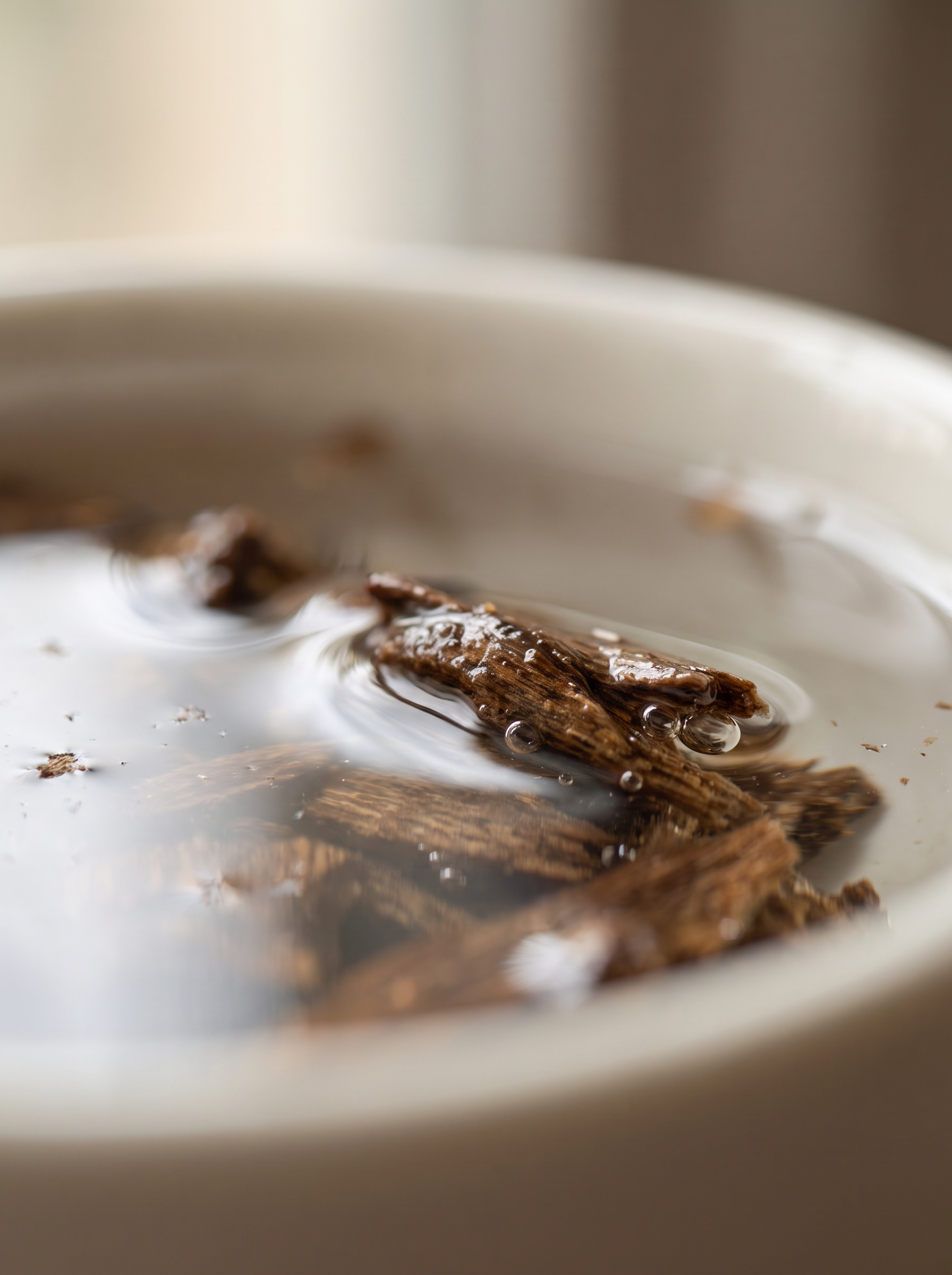
Das Holz
Harzdurchzogenes Kernholz. Je dunkler die Adern, desto dichter das Harz.
04
Die Destillation
Wasserdampf löst das Harz aus dem Holz. Aus Kilogramm Holz werden Milliliter Öl.
05
Die Reifung
Schweiz. Oud Amal ruht sechs Monate vor Filtration und Abfüllung.


Oud refers to resinous agarwood, which primarily forms in trees of the genera Aquilaria and Gyrinops, as well as the fragrant oil extracted from it. Its character can be woody, balsamic, leathery, fruity, or animalic. The decisive factors are the raw material and its processing. A perfume with an oud note may contain natural oud oil, a recreated accord, or both.12
Those who wish to understand oud should distinguish between three things: the tree, the fragrant material in the wood, and the finished composition on the skin. Between them lie biological processes, artisanal decisions, and the work of perfumery. That is precisely where the story of this special fragrance begins.
29 Min. Lesezeit · 29 Quellen
What the word Oud means
The Arabic word ʿūd means wood or stick. In the world of fragrances, Oud usually refers to Adlerholz, Agarwood, or its oil; Oudh is another spelling. The Arabic lute is also called Oud. Naturally, the shared word does not make the musical instrument a perfume raw material.
In trade, several terms are encountered. This overview helps to distinguish between the types of products:
| Term | Refers to | What cannot be inferred from this |
|---|---|---|
| Agarwood or Adlerholz | Wood enriched with fragrances and resin | That every piece has the same fragrance strength |
| Oud oil or Dehn al Oud | A product offered as Oud oil; in the precise sense, the extracted wood oil | That every commercial product is undiluted and unadulterated |
| Oud perfume | A finished fragrance composition with an Oud theme | What proportion of natural Oud oil is contained |
| Oud accord | A composition that creates the impression of Oud | That it consists of a single molecule |
| Mukhallat | A fragrance blend | That it exclusively contains Oud |
| Bakhoor | A term for incense, often a fragrant mixture | That it is pure Agarwood |
| Attar or Ittar | A term for perfume or fragrance oil with regionally varying traditions | A uniform recipe or automatically one hundred percent natural substances |
Oil, incense wood, and blended perfume belong to the same fragrance culture, but are different products. Trade reports document this variety, especially for the Gulf region.3
How Oud is formed in the tree
A healthy Aquilaria tree does not consist of precious, dark aromatic wood throughout. The coveted resin enrichment occurs as a reaction to stress and injury. In doing so, the tree changes its metabolism. Injuries, microorganisms, and other stress stimuli can work together. The often-told story of a single fungus that transforms every Oud tree is too simple.1
Research into inoculation shows that various fungi can trigger such reactions. The tree acts as an active biochemical producer in this process. The organisms living in or introduced to the wood and the tree's defense mechanisms influence each other. Not every treatment produces the same quantity or the same chemical profile.4
The characteristic chemical inventory of agarwood includes Sesquiterpene and 2-(2-Phenylethyl)chromone. However, the resinous wood and its distilled oil are not chemically identical: Distillation primarily transfers sufficiently volatile components. Anyone heating wood, examining an extract, or smelling an oil is looking at different aspects of the same material.1
Where Oud comes from and where it is produced
Its botanical origin is in southern and southeastern Asia. Relevant regions of origin include, among others, Northeast India and Bangladesh, as well as mainland and island regions of Southeast Asia. China is also an important region for Agarwood. Aquilaria and Gyrinops include several species; "Oud" does not refer to a single, globally uniform tree species.10
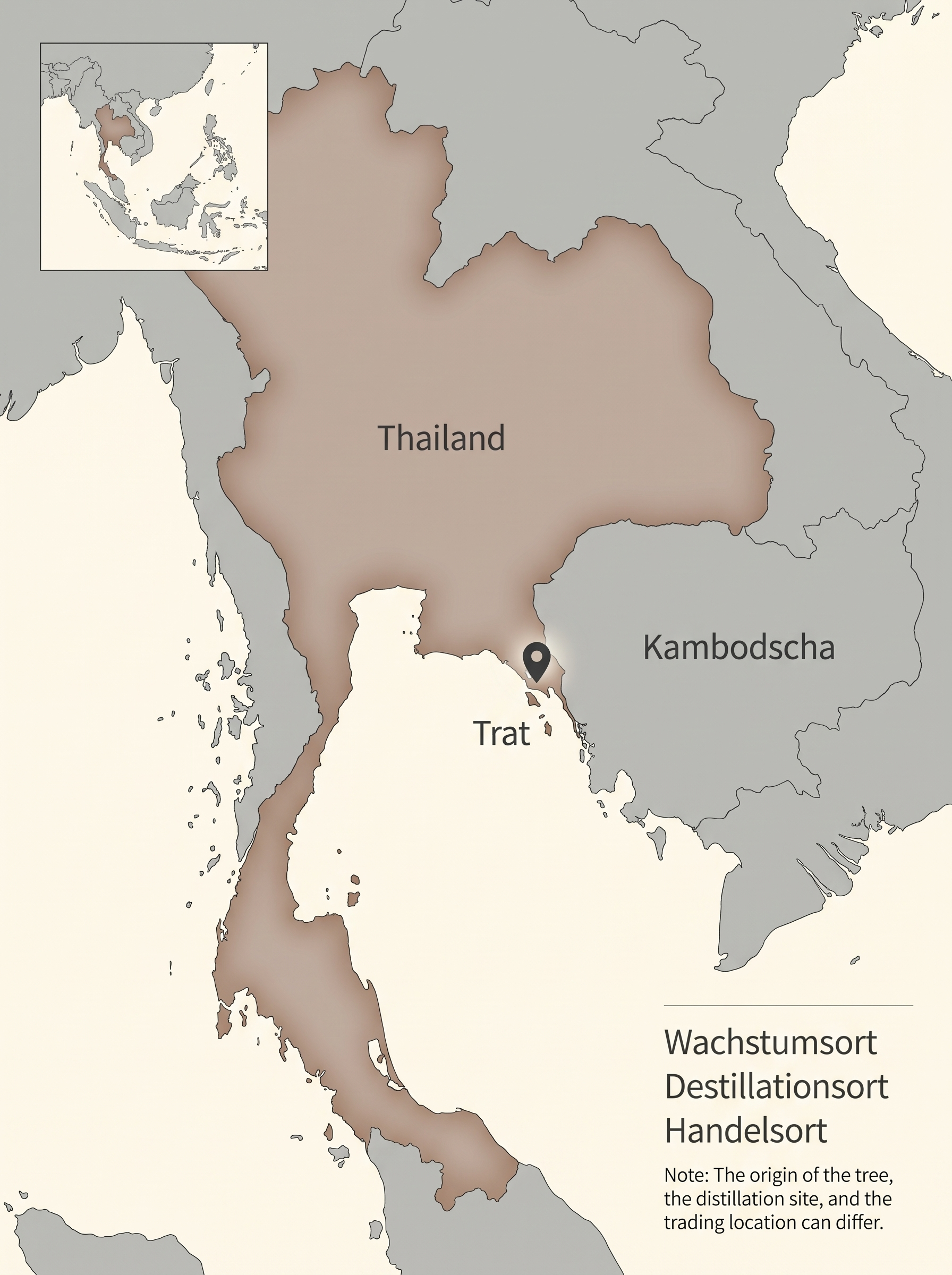
For a specific product, at least three locations must be distinguished: Where did the tree grow? Where was the oil extracted? Where was the finished perfume composed and bottled? In addition, there are countries of trade and re-export. Therefore, a shipment from Dubai does not necessarily consist of wood grown there. Trade in the United Arab Emirates explicitly includes import, further processing, and re-export.3
This distinction also protects against an overly simple fragrance map. A country name can provide orientation. It is not enough to predict the actual scent of a batch.
Oud from Trat in Thailand
Trat is located in eastern Thailand near Cambodia. In the Oud scene, the name stands for a region of origin and processing where cultivated material and artisanal distillation come together. A travel report from a commercial Oud trader in 2023 describes visits to local producers and cultivated Crassna stands. It provides first-hand insights, but remains a report from a commercial market participant.11
What does Oud from Trat smell like? The better answer begins with a sample. Sweet, fruity, woody, leathery, or animalic impressions may fit the description of a specific oil. They are not a binding definition of the province. With Oud in particular, the name of the origin and the style of production are closely intertwined: anyone who prepares or distills the same raw material differently can produce a different emphasis.
A manufacturer's report describes various distillations of Trat wood in Thailand, Assam, and Pakistan. This is a vivid indication of the importance of the process. Since several conditions changed simultaneously, the comparison does not prove what role water, climate, equipment, or working method played in each case.12
For an Oud from Trat, the following details are therefore valuable: the identity of the producer, the botanical species, the location of the tree stand, the form of cultivation, the harvest batch, and the location of the distillation. "Purchased in Thailand" is a different statement than "obtained from trees in Trat." Whoever distinguishes this cleanly tells a more interesting story of origin.
Ob ein Duft echtes Agarholz enthält oder einen Akkord, zeigt sich in Stunde drei bis sechs — nicht in den ersten zehn Minuten.
We use cookies to improve your experience and analyze site traffic, in accordance with Swiss nDSG and EU GDPR.